Friday, August 14, 2009

Review: 'The Barcelona Cookbook'


The Barcelona Cookbook: A Celebration of Food, Wine and Life. Sasa Mahr-Batuz, Andy Pforzheimer. Andrews McMeel Publishing, $29.99 (224p) ISBN 978-0740773945

A cookbook about Barcelona? With recipes of all those great things I ate when I was there this spring? When I first heard about 'The Barcelona Cookbook' that's exactly what I thought. Then when I received it for review I discovered that it wasn't that at all. Instead it's a cookbook based on a Connecticut restaurant group: Barcelona Wine Bar and Restaurants. The concept is tapas and wine; the restaurants have been around since 1996. The book's subtitle is: A Celebration of Food, Wine and Life. When co-owners Sasa Mahr-Batuz and Andy Pforzheimer opened their first restaurant they decided to name it after the city of Barcelona because of its vibrancy, and colorful lifestyle -- its 'cosmopolitan, pan-European' feel. They wanted to evoke the feeling of eating in a restaurant along the Mediterranean coast. However, the dishes served in the restaurants, and the recipes used in the cookbook, are not solely Catalan or Mediterranean. Mahr-Batuz and Pforzheimer have traveled to Spain often so the dishes on the restaurant menus come from all over Spain, or are Spanish-influenced; Mahr-Batuz is originally from Argentina so there are Argentinian influenced dishes as well.

When I first read through the book I was surprised and pleased to see that Chef Pforzheimer gave credit to Chef Jeremiah Tower, and the Stars restaurant chefs, for teaching him hands on skills he would later use in a successful career as a chef and restaurant owner. Being that I also worked in and have an association with Chef Tower and Stars it was a comfort to see that. I knew right away he had a good cooking pedigree. I was also happy to see that Chef Pforzheimer's menu choices are influenced by what is available from local farmers and farmers markets. Another area I believe in strongly: living life locally.

I have found with other restaurant cookbooks that the recipes don't always work. It can be difficult to translate dishes made in a professional setting to the page for the home cook. Professional chefs cook differently than the home cook; they also have different equipment at their disposal. I didn't find that to be the case in the recipes I tried from 'The Barcelona Cookbook.' The recipes worked just fine. I chose to try recipes that I had recently eaten in Barcelona -- to see how they measured up. One of my favorite dishes on that trip was patatas bravas -- olive oil fried potatoes served with a spicy mayonnaise. It's a very simple dish and the cookbook's recipe for 'Catalan Potatoes Bravas' measured up perfectly. I was momentarily transported back to my favorite tapas bar in Barcelona. Being that it is currently summer I have been overwhelmed with farmer's market produce; needing to use up all those pesky organic tomatoes I made the 'Barcelona Gazpacho.' An easy recipe to follow and execute, and the added touch of a garnish of day old bread, scallions, cucumbers and green peppers made this cold soup exceptional. Since meat is almost a national pastime in Spain I decided to try a recipe for grilled steak: 'Steak Paillard.' The recipe includes a delicious bell pepper and tomato vinaigrette that is spooned over the grilled meat, as well as fried potatoes. Simple, basic and a perfect summer evening meal.

To me the book echoes what Andy and Sasa seemed to have set out to do in their restaurants: offer a fun, festive, colorful place to eat well-prepared food, drink great cocktails, and taste good wine. The book has a similar feel. The color photos are plentiful and well shot; a mixture of ingredients, dishes, kitchen and dining scenes from the restaurants, and photos of Spain. The two men state that the restaurants are foremost about entertaining people; sections of the book are devoted to throwing parties. There's a whole chapter on cocktails and wine. Interspersed throughout are little histories and commentaries on Spanish food, wine, cheese, cured meats, trips to Spain, and the city of Barcelona, among others. They also include recipes for a number of stock Spanish dishes: sangria, cazuela, albondigas, zarzuela, romesco sauce, paella, gazpacho, arroz con leche and others. Well explained cooking techniques for many of the dishes are added value. Looking at the dishes, the recipes, and the ingredient lists that include such things as olive oil, garlic, tomatoes, paprika, cured meats, seafood, and saffron rice I could easily smell and taste the food, and was almost transported back to Spain.

The book covers a lot of ground, and if I was going to offer any criticism that might be it; there's a lot contained in its 202 pages. It might also suffer from a bit of an identity crisis in that I did think it was a cookbook about food from Barcelona; and it does veer away from strictly Spanish food to include dishes from South America. Once the reader understands what the restaurants are about that is easily overlooked. And if one is looking for a serious Spanish food cookbook, this is it. It has most of what you would want and need plus more. I do wish there was a recipe for one of my favorite Spanish tapas dishes: Padrón peppers. But there is enough else to make this a worthy addition to any cook's bookshelf.

My Status: going on vacation for a week to Guerneville-Russian River-Sonoma County. Lunch at pork store Black Pig Meat Co. and restaurant Bovolo in Healdsburg; dinner at Zazu Restaurant & Farm in Santa Rosa; wine tasting at Chalk Hill, Hop Kiln, others in the Alexander Valley, Healdsburg and Sonoma County; canoeing on the Russian River, and more...

Upcoming Posts: 'gleaning,' or the act of gathering public produce, or leftover farmer's market produce, and giving it to the poor, needy and hungry. A history of the movement
, and the groups that are actively involved in it.
Bookmark and Share

Monday, August 10, 2009

Iceberg Lettuce & My Recipes & The Wedge Salad


History captures most people's interest; it does mine. But food history I find fascinating. I've been wanting to write about a favorite salad for awhile now because it's so simple, and because of one chief ingredient. The salad is the wedge salad, and the ingredient is iceberg lettuce. The wedge salad would not exist (as well as it does) without iceberg lettuce. Few other lettuces are 'wedgy' lettuces. Few others have the cabbage-like construction that allows iceberg to be cut into wedges that stay wedges.

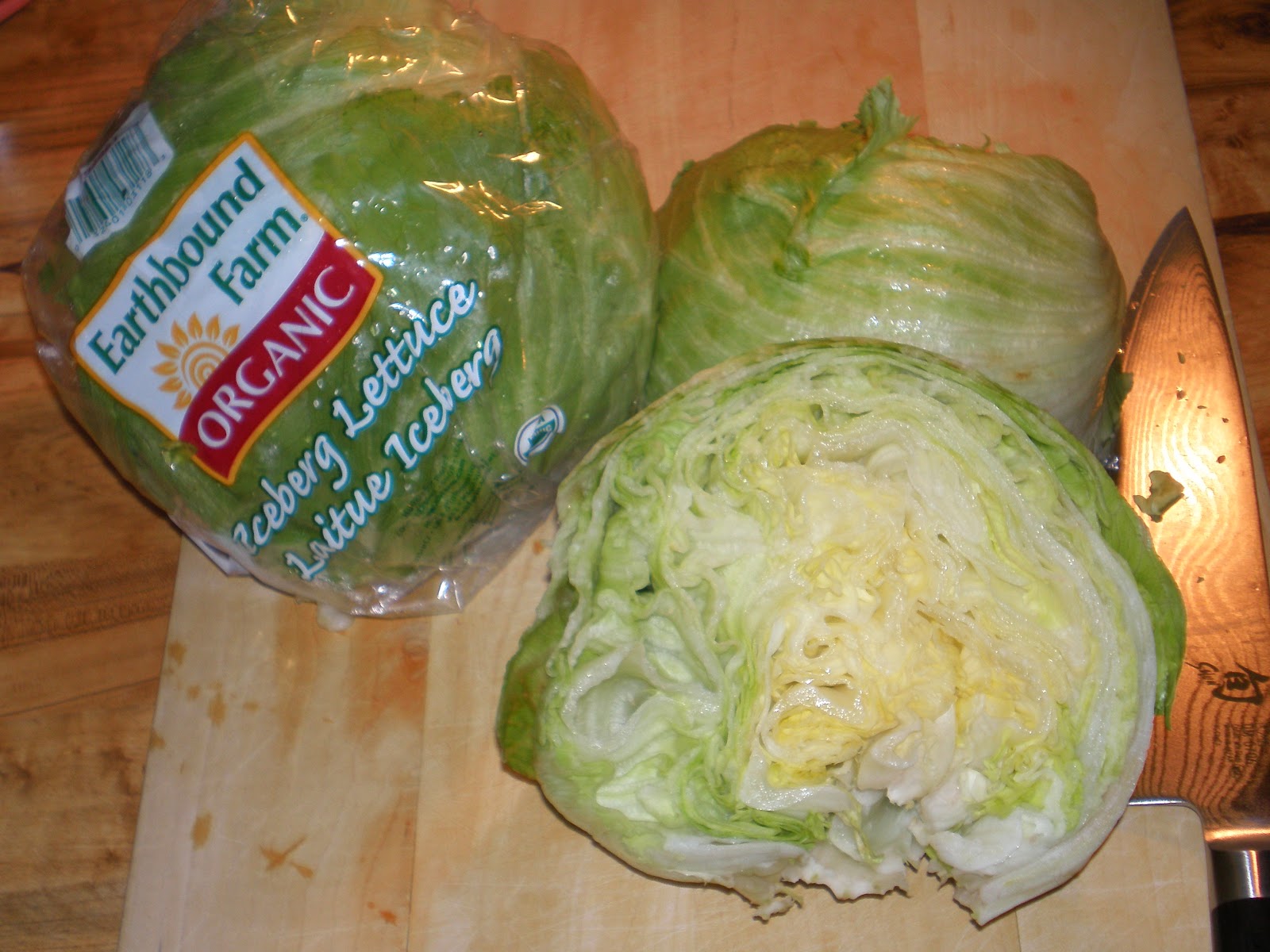
This interest in the wedge salad and iceberg lettuce started a few years ago when I was having dinner in St. Helena in the Napa Valley and ordered a wedge salad. Being the food and wine mecca that the area is, this was no ordinary wedge salad. Very unlike those found in your average steak house. The lettuce was somehow different. If it was iceberg it was not iceberg like I was used to. The leaves weren't as tightly packed; the color was a greener hue of green. It just seemed healthier, more appealing than the drab iceberg I grew up with. It was a delicious wedge salad made with top notch ingredients. It was a bit like I was eating the wedge salad reinvented. I wanted to eat it again. First off I wanted to know if there was organic iceberg I could use instead of commercially farmed iceberg. Turns out there is.

Iceberg Lettuce

Like most Americans of a certain age I grew up eating iceberg lettuce. It was just what we ate. There may have been other lettuces available but I don't think we ever bought any. I only remember the pale green, tightly wound, heavy, tasteless balls of iceberg wrapped in clear plastic netting that went into everything that required lettuce. It wasn't until I lived in France that I realized there were other lettuces and salad greens out there. I still to this day have a distaste for iceberg. I've become a lettuce snob. Give me mesclun, frisee, endive, Boston, Bibb, or romaine over iceberg any day.

Iceberg lettuce has quite the history. It is referred to as a 'crisphead' cultivar because it resembles cabbage, and because of its ability to stay fresher longer than looser leaf lettuces. Until the 1930s it was called 'crisphead' lettuce not 'iceberg'. Iceberg is one variety of crisphead lettuce; others include imperial, Great Lakes, vanguard and western. There are several stories, or theories, as to why it came to be called 'iceberg.' The most popular notion is that at the advent of cross continental rail shipping, and before refrigerated rail cars, it was packed in wooden carts with lots of crushed ice making the carts look like icebergs. When the trains pulled into stations the local townsfolk called out "the icebergs are coming, the icebergs are coming" and the name stuck. Another source says the name refers to the 'crisp, cold, clean characteristics of the leaves.'

There is one other piece of iceberg history that I found interesting. I thought, like others I am sure, that iceberg went out of favor in the late 70s and early 80s when California Cuisine hit the nation's radar and restaurants like Chez Panisse taught us there were other lettuces and greens to eat besides iceberg. It turns out it may have started a bit earlier when Cesar Chavez organized a boycott to protest the working conditions of lettuce pickers in the fields of California. The boycott shut down iceberg production in California. Other lesser known lettuces stepped in to take it's place. Then the food movement kicked into full gear moving away entirely from iceberg. Yet, even with those changes, and based on available statistics, Americans today still eat more iceberg than any other lettuce.

Not everyone has an aversion to iceberg. James Beard said this about it: "Many people damn it but when broken up, not cut, it adds good flavor and a wonderfully crisp texture to a salad with other greens." From Nancy Silverton: "I'm proud to love it, and I have always loved it. It's something I absolutely crave."

My Recipes

Since I am writing about the wedge salad, and including a recipe, I wanted to write about a favorite site for recipes: MyRecipes.com. MyRecipes.com is a wonderful online food portal with over 35,000 kitchen-tested recipes, and food and health-related articles. The site culls recipes from all of Time Inc.'s food titles: 'Real Simple,' 'All You,' 'Cooking Light,' 'Southern Living,' 'Sunset,' 'Coastal Living,' 'Cottage Living,' and 'Health.' Every recipe is tested in professional test kitchens and approved by food editors, chefs, dietitians, and food scientists.

I recently spoke to Anne Cain, a Senior Editor at MyRecipes.com, about the local, fresh, organic, back-to-home-cooking, slow food, farmers market movement going on here in the U.S. She felt that while it is about economics, reducing our carbon foot print and helping out the environment it's also that the food simply tastes better. "The real reason to eat local is because it tastes better. It's so much fun to know the people who grew, or made, your food. There's no better flavor." Can't argue with that. The site even has a weekly web series called 'Local Flavor' where 'Cottage Living' editor and best-selling author, Kim Sunée, discovers and highlights people passionate about local food. Another feature is the slide series 'Eat For Pleasure, Eat Local' that focuses on the local food movement and includes recipes and links to ingredients made by smaller, sustainable purveyors. Both can easily be found via the site's search features. The site also has a 'search by ingredient' feature. When I typed 'wedge salad' into the search feature several recipes popped up. I often check in with MyRecipes.com when I'm looking for a recipe, or researching a blog post.

The Wedge Salad

There are so many recipes for this dish out there; having been served in many a hotel restaurant and steak house since the early 1900s it also has a long history. But the main ingredients have remained the same over the years: iceberg lettuce, bacon and blue cheese dressing. I chose to make the dressing from scratch; there are plenty of recipes that tell you to use bottled dressing. I also added fried onions. Most recipes don't call for them. I also learned that organic lettuce does exist; I bought it at Whole Foods. The only organic iceberg Whole Foods had was from Earthbound Farm, located in Carmel Valley, California. It's funny but since I don't buy iceberg lettuce I never actually looked for an organic version when I went to the grocery store. When I did an online search Earthbound and Whole Foods came up. Now I know where to buy it for my next wedge salad fix.

WEDGE SALAD

Preparation Time 30-45 minutes

Serves 2-4

Ingredients

1 head iceberg lettuce, organic if possible
1 medium-sized onion, sliced
4-6 slices bacon
6 oz. blue cheese
3 - 4 Tbsp. olive oil
1 Tbsp. lemon juice
1/4 tsp. ground white pepper
Pinch of salt
1/2 cup buttermilk
1 Tbsp. chives, finely chopped


Cook bacon in large skillet until crisp; remove and drain on paper towels.


Using the same skillet reserve enough bacon fat to fry the onions for 10 minutes or until tender and lightly browned. Remove from heat.


Place the blue cheese, olive oil, lemon juice, pepper, salt and buttermilk into a blender or food processor, and blend until smooth. Use the buttermilk to thicken or thin as needed. Set aside.


Use a knife to remove the core of the lettuce head, or bang the stem end down on your kitchen counter; the core will pop right out. Remove any old outer leaves, and rinse. Cut the head in half then cut those two halves in half resulting in four wedges. For an entree portion for two people place two wedges each on two salad plates. If a first or salad course for four, place one wedge on four salad plates.


Lay the onions across each wedge. Crumble the bacon and sprinkle over the onions.


Drizzle the blue cheese dressing over each wedge, sprinkle with chives, and serve.


My Status: enjoying all the summer produce; writing, cooking, blogging and eating!
Upcoming Posts: Review: 'The Barcelona Cookbook'.


Bookmark and Share

Wednesday, August 5, 2009

Recipe: Ratatouille


I recently picked up Julia Child's cookbook 'Mastering The Art of French Cooking' again after a very long time. Fond, fond memories poured forth from the stained pages. The spine has come loose; the book is worse for wear. I could replace it with a fresh copy, one of the recent editions, but I probably won't. It's like a comfortable pair of jeans. Like an old friend. I looked at the copyright and was shocked to see that the edition I have is the twenty-ninth, and was published in 1977 -- the year I graduated from high school, and the year that I left home and family to go live with and cook for a French family in France. I actually used a copy of 'Mastering' that Madame Zundel, an American woman married to a Frenchman, had in her kitchen when I did the family's cooking. I wonder how many other Americans were introduced to French cooking in France while using Julia's cooking bible? I bought the book when I returned from France in 1978 so I have had it for thirty-one years. An old friend indeed.

Since I started the Auntie Em's produce delivery - where I get a nice selection of farmers market produce delivered to me once a week - I have been trying very hard to eat it all. To not throw anything out. And now in week five I have for the most part succeeded. The amount of fruits and vegetables I receive is more than enough for myself. If I didn't have Robert coming over a few times a week I probably wouldn't be able to eat it all. Between the two of us we manage to get through it. However, this last week I did have more than I knew we could handle. So I decided to make something that would use up all the vegetables I had: tomatoes, eggplant, peppers, zucchini and onions. Ratatouille has all those vegetables in it. It would also be a perfect summer dish as it can be eaten either hot or cold. I grabbed 'Mastering The Art,' flipped to the recipe for ratatouille, and spent an afternoon in the warm embrace of Julia. What could be more appropriate in what has seemingly become the unofficial month of Julia Child?

Here's the recipe:

RATATOUILLE
From 'Mastering The Art of French Cooking'

Serves 6-8

Preparation Time: 3-4 hours

Ingredients

1/2 lb. of eggplant
1/2 lb. of zucchini
7 Tb of olive oil, more if needed, as directed
1/2 lb. of yellow onions, thinly sliced
2 (about 1 cup) green bell peppers, sliced
2 cloves garlic, mashed
1 lb. firm, ripe, red tomatoes, peeled, seeded, and juiced
3 Tb parsley, minced
Salt and pepper, as directed


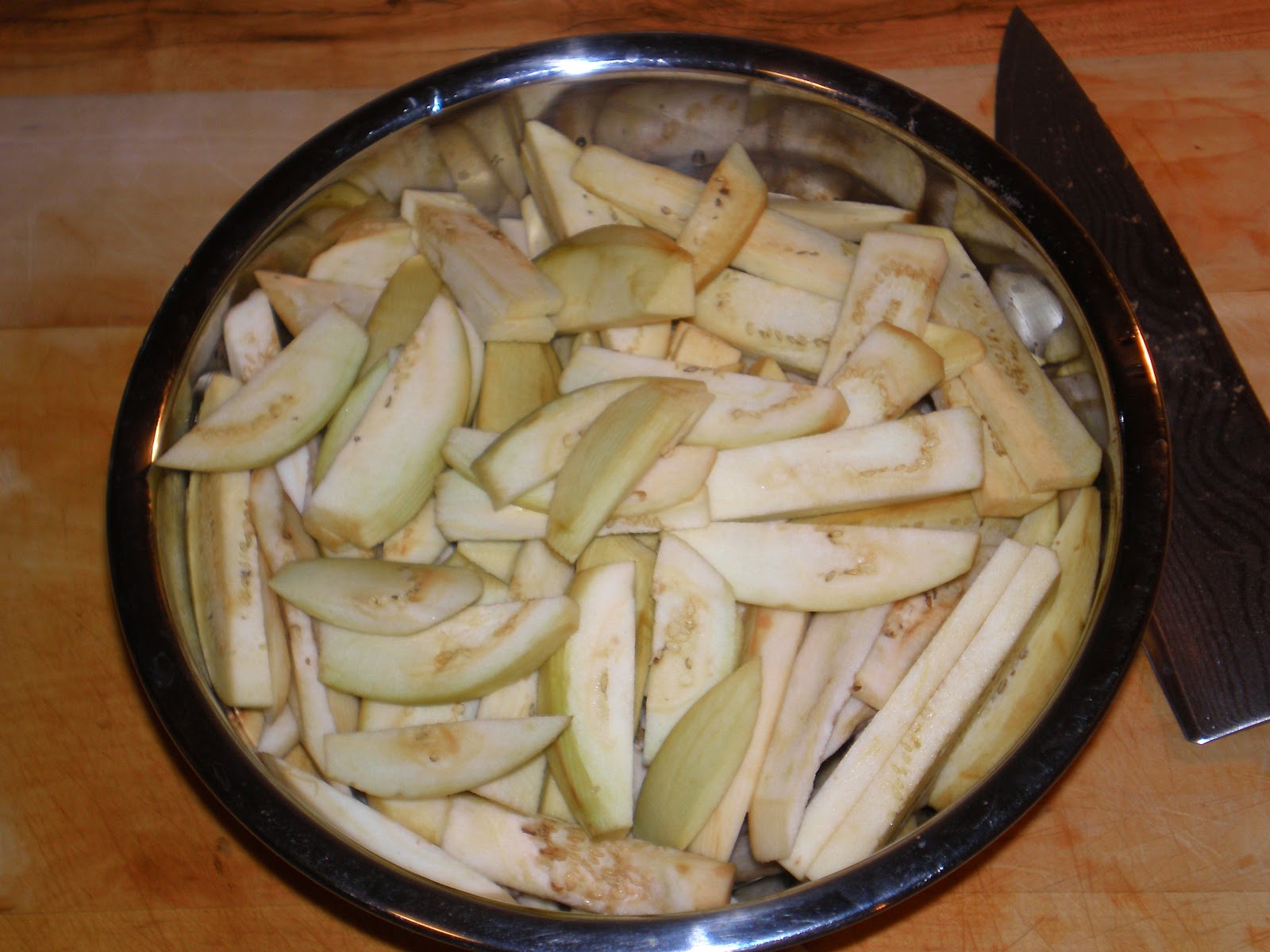
Peel the eggplant and cut into lengthwise slices 3/8-inch thick, about 3 inches long, and 1 inch wide. Scrub the zucchini, slice off the two ends, and cut the zucchini into slices about the same size as the eggplant slices. Place the vegetables in a 3-quart, porcelain or stainless steel mixing bowl and toss with 1 tsp. salt. Let stand for 3o minutes. Drain. Dry each slice in a towel.


In a 10- to 12-inch enameled skillet sauté, one layer at a time, the eggplant, and then the zucchini in hot olive oil for about a minute on each side to brown lightly. Remove to a side dish.


In the same skillet, cook the onions and peppers slowly in olive oil for about 10 minutes, or until tender but not browned. Stir in the garlic and season to taste.


Slice the tomato pulp into 3/8-inch strips. Lay them over the onions and peppers. Season with salt and pepper. Cover the skillet and cook over low heat for 5 minutes, or until the tomatoes have begun to render juice. Uncover, baste the tomatoes with the juices, raise the heat and boil for several minutes, until juice has almost entirely evaporated.


Place a third of the tomato mixture in the bottom of 2 1/2 quart fireproof casserole and sprinkle over it 1 tablespoon of parsley. Arrange half of the eggplant and zucchini on top, the half the remaining tomatoes and parsley. Put in the rest of the eggplant and zucchini, and finish with the remaining tomatoes and parsley.


Cover the casserole and simmer over low heat for 10 minutes. Uncover, tip casserole and baste with the rendered juices. Correct seasoning, if necessary. Raise heat slightly and cook uncovered for about 15 minutes more, basting several more times, until the juices have evaporated leaving a spoonful of flavored olive oil. Be careful of your heat; do not let the vegetables scorch in the bottom of the casserole.


Set aside uncovered. Reheat slowly at serving time, or serve cold.

Here's to Julia and, as she would say: Bon Appétit!

My Status: enjoying all the summer produce; writing, cooking, blogging and eating!

Upcoming Posts: The Wedge Salad: a recipe, the origins of the salad and of Iceberg lettuce. Review: 'The Barcelona Cookbook'.
Bookmark and Share

Tuesday, July 28, 2009

The Local Report - Auntie Em's Kitchen


4.2 miles, about 12 minutes, from my home in Atwater Village.

I like my neighborhood. It feels like a neighborhood. In Los Angeles that's saying something. Neighborhoods here can comprise large geographical areas. Maybe they're actually more 'areas' than neighborhoods. I've lived in other areas of L.A.: the Fairfax district, Hollywood, West Hollywood. I moved to the eastside of Los Angeles in 1999; to Silver Lake. I quickly fell into the whole scene, the Silver Lake vibe. It reminded me of San Francisco, the East Village in New York: it wasn't L.A. Funky, more laid back, more creative, more mixed: socially, economically, racially. I'd found my L.A. home. It all worked for me. I now live in Atwater Village -- really just Silver Lake adjacent. Still quite happy in the neighborhood.

One of the reasons I like my 'hood so much is the preponderance of locally owned and operated businesses: cafes, restaurants, bars, stores and shops. Auntie Em's Kitchen is one such local business. Located in Eagle Rock, a neighborhood to the east of Atwater Village, it's a longtime fixture in the Eastside dining establishment. Owned by the indefatigable Chef Terri Wahl, the food is local, seasonal and prepared and served with a down home spirit that makes the dining experience fun and relaxing.

Robert and I had lunch there the other day. The place reminded me so much of the funky, vegetarian, hippy places I used to see all along Haight Street in San Francisco in the early 80s. Things at Auntie Em's are loose around the edges, very laid back. Want coffee? Go to the self-serve coffee island and help yourself. The room we were seated in had a reach-in refrigerator that the cooks came to for supplies. In the back was a refrigerator case full of cheeses for sale. Not only does Auntie Em's have a cafe and bakery but they also cater, sell housewares, condiments, sweets and cheese, and they recently began a farmer's market produce delivery service. I signed up for the produce delivery and I love it. Terri and her staff keep a keen eye out for whatever is fresh and seasonal. They shop at the local farmer's markets, and they work with local farmers and purveyors to keep up with what is seasonably available. The restaurant's menu changes according to what is fresh and available.

We both ordered salads; Robert had the Tossed Cobb -- chicken breast, applewood smoked bacon, avocado, blue cheese, egg, tomatoes, scallions and romaine lettuce tossed with a house dressing. I had the Grilled Steak -- thinly sliced marinated skirt steak, tomatoes, carmelized onions and blue cheese served on baby greens. The waitress told us that the first thing they were famous for was the cobb salad. The next thing was the red velvet cupcake -- a mini one of which came with the check gratis.

Auntie Em's Kitchen is a full-service fresh, organic, local and sustainable operation. My kind of place. I am glad it's part of my neighborhood.

My Status: enjoying all the summer produce; writing, cooking, blogging and eating!

Upcoming Posts: The Wedge Salad: a recipe, the origins of the salad and of Iceberg lettuce. Review: 'The Barcelona Cookbook'.

Bookmark and Share

Friday, July 24, 2009

Recipe: Padrón Peppers


Are they Italian or Spanish? I was *confused and still am. I first had something like
pimientos del Padrón in Ravello, Italy while on a three week trip to France and Italy with my friend, Chef Jeremiah Tower. We spent the day driving along the Amalfi Coast stopping in at all the beautiful towns along the way. On our way back to our apartment further south along the Campania coast, we decided to drive over the mountains that hug the Amalfi Coast and stop in Ravello. Ravello sits high up in the mountains overlooking the Amalfi Coast. After a winding drive up the mountainside we pulled into the town square and, as always, I was hungry. We went into the first ristorante we saw, sat down at the bar and ordered drinks. I looked over the menu and noticed something that said fried green peppers. They sounded interesting so I ordered them. A few moments later they were placed on the bar before us: a plate full of freshly fried small green peppers, stems attached. They were about the size of a jalapeño but didn't have that kind of heat. There was just a hint of heat. They were lightly salted. Perfect bar food. We gobbled them down with our drinks. And I wanted more. But we didn't order more. I have wanted more ever since.

Flash forward to my recent trip to France and Spain with Robert. We're sitting in
Cervecería Ciudad Condal on our first night in Barcelona and I see on the table next to us a plate of fried green peppers. They looked exactly like the peppers I remember eating in Italy. I quickly scanned the menu and there they were, 'pimientos del Padrón' -- they were a Spanish tapas dish. They were lovely, and wonderful, and delicious: fried perfectly in Spanish olive oil, dusted with large-grain salt. Grabbed by their little stems, bitten into and pulled off with your teeth, an explosion of crispy skin, salt crunch, slightly bitter pepper taste, a little fire, and olive oil. Drop the stem on your plate, grab another one, repeat. Of course they were gone too soon. I wanted more. I ALWAYS want more of delicious things. Just the kind of eater I am but we moved on to all the other amazing food we ordered. We spent two more nights in Barcelona and we had pimientos del Padrón at each of those meals.

Like I tend to do with my crazy delicious food experiences I have been dreaming about eating those peppers again since I've been home. I did a little Internet research and found out that they come from
Padrón, a municipality in the area of northwest Spain called Galicia. They are grown and harvested from June to September, and eaten all over Spain. What I didn't know about them is that they are also known as 'Russian roulette peppers,' in that one in ten can be extremely hot. As in you bite into it and immediately the heat sears your tongue and mouth, smoke comes out of your ears like in the cartoons, and you think you'll die. When we ate them in Barcelona they were all fairly mild; neither of us came across any with super-fire. I found out that as the season progresses, the hotter they get. August and September peppers are much hotter than early season peppers. I also found out that they are difficult to find in the U.S. however, one company, La Tienda, does sell them via mail order. La Tienda is based in Virginia, and specializes in Spanish food products. Their website states that Virginia is on the same latitude as Galicia so it's perfect for growing these peppers. They grow them from seeds that came from a pepper farmer in Padrón. I placed an order. Three weeks later one pound, or about one hundred peppers, arrived via U.P.S. in a styrofoam container with an ice pack.

When my Spanish friend,
Júrgio (pronounced 'sure-show'), heard that I had pimientos del Padrón he was quite surprised. Júrgio, who is Galician and knows Padrón and the peppers well, has lived in Los Angeles for a number of years and has never seen them here. We made a dinner date for the following night to cook them. Júrgio helped me make them and I am glad he did. From watching his mother cook them as a child, he knew things about preparing them that I did not. He told me there are pepper sellers in Padrón, little old Spanish ladies, who can tell how hot the peppers are just by looking at them. When you shop for them there, they ask how much heat you want. Júrgio, his partner Kevin, Robert and I ate all one hundred of them in a matter of a few minutes. There was no Russian roulette for us however. We didn't get any really hot ones. So I've still not eaten one that sends me shooting out of my chair and into the fountain in the square outside. An experience for another day. Lack of heat aside, Júrgio approved; they tasted just like they do in Spain. I was so happy to eat them again!

*Coda: I have yet to figure out how the Italian peppers we ate differ from, or are similar to, the
pimientos del Padrón. If anyone knows, please let me know. Otherwise, I'll do more research and write about what I find in a future post.


Here's how we made them:

Pimientos del Padrón

Ingredients

1 lb.
Padrón peppers (80-100 peppers)
3-4 cups olive oil
Salt, large grain rock, Kosher, sel de mer, etc.

Clean the peppers by rinsing them lightly. Dry them completely so they won't splatter when they hit the hot oil. Leave the stems attached.

Place the olive oil in a large skillet suitable for deep frying, like a cast iron skillet. You may also use any other type of deep fryer you have on hand. Allow the olive oil to heat on medium to high heat. It will take awhile to get to the right temperature. When you think the oil is close to being the right temperature, place a small piece of bread in it. When the bread begins to bubble and crisp up, the oil is ready.
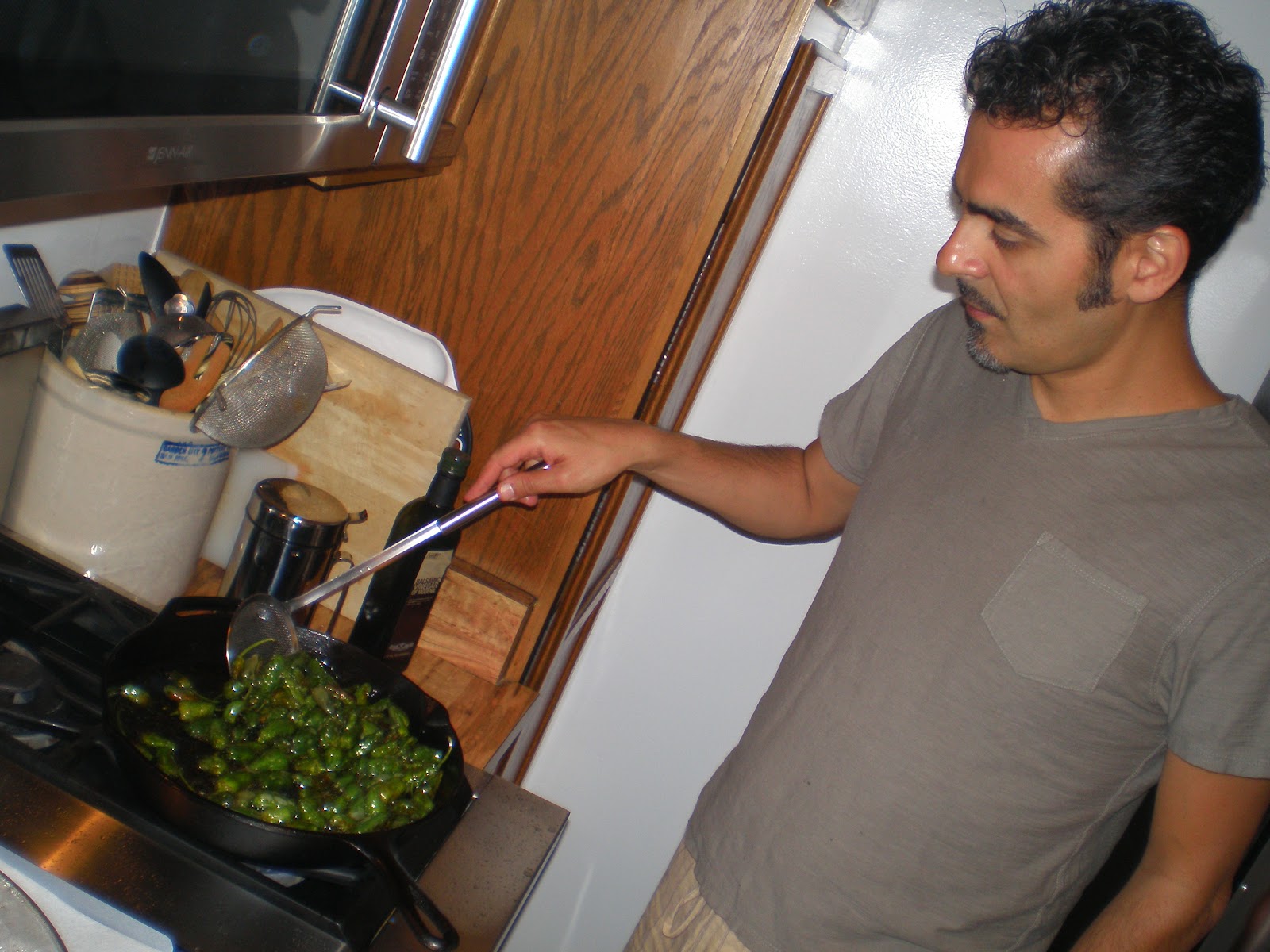
Place all of the peppers in the heated oil; it will take a moment or two for them to begin cooking. Stir or turn with a metal slotted spoon or sieve. Once they are bubbling and boiling in the hot oil watch for the skins to start puffing and wrinkling. This should only take a few minutes.

Remove the cooked peppers from the oil and place on a baking sheet lined with paper towels to drain off excess oil.

Place on a serving platter, and sprinkle generously with the salt.


My Status: it's still hot in Los Angeles - upper 90s, summer is really here; enjoying all the summer produce; writing, cooking, blogging and eating!

Upcoming Posts: The Wedge Salad: a recipe, the origins of the salad and of Iceberg lettuce. Review: 'The Barcelona Cookbook'.
Bookmark and Share

Monday, July 20, 2009

Gardening & Auntie Em's Produce Delivery


Me, age 2 1/2, helping water Grampa Rollie's garden, Arroyo Grande, California, March 1962.

Gardening

Gardens were a big part of my childhood. As long as they were alive my great-grandparents, Rolla and Ora Goodman, had a bountiful garden. Lucky for me they both lived until I was in my teens. The garden I remember the most, and spent the most time in, and ate the most food from, was the one they had at their modest little home in Orcutt, California, along the Central Coast of California. Each visit my sister, Traci, and I would spend hours down in the garden; eating strawberries right off the vine, pulling up carrots for the mid-day meal, helping Grampa Rollie water or weed. I learned a tremendous amount about gardening from them, and from helping out in their garden.

When I was around eleven or twelve my mother let me plant a few rows of vegetables in our backyard. We were living in San Luis Obispo, also on the Central California Coast, not far from my great-grandparents, and I wanted to apply what I had learned from them. I think I planted some zucchini, Swiss chard and tomatoes, maybe a few other things. And I believe I was able to get a small harvest from it. Our neighbors, across Pismo Street, were Mr. and Mrs. Tanner, and he was quite the gardener. I spent a lot of time with him in his garden. He had the touch; his plants were healthy and very productive. He sent me home with zucchini, tomatoes and any other surplus he had each time I crossed the street to visit him. He also came over and offered his advice about my fledgling few rows. After my first few successes, and after eating my own home grown vegetables, gardening really got under my skin.

Then I grew up. I went to live in Europe, then San Francisco, New York and Los Angeles. Gardening quickly took a back seat to living life in the big city. To work, school, and a busy social life. I lived in apartments not in houses with yards; there was no real property to plant a garden. I currently live in a condo with little available outdoor space. A poor excuse, I know that many people find ways to plant vegetables in very small areas but it's my excuse nonetheless. I replaced 'garden fresh' with 'farmer's market fresh' and at least I had that. Enter Auntie Em's Kitchen in Eagle Rock, California -- a mere 4.2 miles, 12 minute drive from my home in Atwater Village.

Auntie Em's Organic Produce and Dinner Delivery

Auntie Em's is quite the food enterprise. Located on Eagle Rock Boulevard, there's a cafe and bakery that serves fresh, healthy food using 'seasonally available fruit, vegetables, meats, poultry and fish'. The cafe menu and bakery items offered change according to what is seasonally available. My kind of place! They also have a marketplace that offers cheeses, condiments, sweets, Auntie Em's frozen dishes, tableware and gift baskets; and they offer full catering services. Their newest venture is a farmer's market produce delivery service: 'Auntie Em's Organic Produce and Dinner Delivery'. The service brings 'locally grown, organic, seasonal produce and heatable meals and baked goods to your doorstep'. I am in my third week. And I love it.

They go around to local farmer's markets, gather whatever is fresh, seasonal and wonderful, and deliver it to my doorstep once a week. The produce they have chosen has been top notch: fresh and full of flavor. It lasts longer than anything I buy in a grocery store. Some of the local farms that the produce comes from are Wieser Farms, South Central Organic Farms, McGrath Family Farms, K and K Farms, Jiminez Farms, Tutti Frutti Farms and Finley Farms. My delivery arrives on Monday afternoons but on Sunday an e-mail arrives with a list of the items to expect; often there are notations about a specific item, a way to prepare it, or store it. Usually there's a suggested recipe for one or two of the items. Have I said I love this? It's almost like having my own garden -- okay, okay, I did say 'almost.' Another reason I like it is I had been finding it difficult to get to my local farmer's market on a regular basis depending on what else was going on in my life. It has been a perfect solution. I have yet to try the heatable meals and baked goods as the produce is more than enough to feed me for a week but I will try them soon.


Week #1 produce delivery: Candy Striped Beets, Red Carrots, Red Butter Lettuce, Lemon Cucumbers, Leeks, Green Beans, Purple Pole Beans, Saturn Peaches, Majestic Pearl White Nectarines, Black Plum Cherry Tomatoes, Purple Cherokee Tomatoes, Red Onions, Ronde Nice Zucchini, Chiles

Last week's e-mail had an additional touch: a story written by Auntie Em's owner, Terri Wahl, about her gardening trials and tribulations over the years. I found it so interesting and charming that I asked her if I could re-post it, and she agreed. As you will see gardening is not always easy but as both Teri and I know it is immensely satisfying. When the carrot you put in your dinner salad comes out of the garden your hands planted, there's no feeling, or tatse, quite like it.

In Terri Wahl's own words...

I have such a giant respect for farmers -- especially organic farmers after the trials and tribulations with my own garden. I have had a garden every year, in every apartment, duplex and now the house that I live in. When I was eighteen, I moved out of my parent's house, into a 4-plex. I was on the second story. I started a little garden in pots on the balcony. Herbs, cherry tomatoes and carrots. The carrots didn't do too well, the herbs did pretty well, and the cherry tomatoes grew like weeds. My mother was always an avid gardener. She had compost piles before it was the cool thing to do. She explained to me that the things that I planted in pots would do much better if they were in the ground. More nutrients, more water, more sunlight. I dug up parts of yards in rented apartments to plant my little gardens (boy were the landlords pissed). I tore out the ugly perennials the gardeners planted in front of another apartment I lived in and planted away (not enough sun there). But I never gave up.

There were successes along the way, even great veggies that I grew. Back then if you saw mold on the leaves of a zucchini plant or motes on the underside of the leaves of a tomato plant, it was fine to blast them with some crazy toxic anti bug spray. Back then it was also fine to sprinkle everything with some kind of powder that would make everything grow huge. But over the years we have all learned that these pesticides and sprays were harmful, and not the proper way to garden or eat. In the house my husband and I live in now I have had an organic garden plot in four or five different places on our hillside backyard. One place was too shady, one place smack in the way. THEN three years ago, the attack of the gophers. I really thought I'd found the absolute perfect spot. My pastry chef, Michael, and I dug it over, added organic Amend and compost, measured out the perfect rows, and planted every row from seed: heirloom carrots, heirloom beets, Easter egg radishes, leeks, Little Gem lettuces, and rows of different herbs.

I really thought that this was going to be the best and most prolific garden yet. We did everything right. I had plans to use all the produce at the restaurant, and to eat from the garden at home and not buy produce for months, and then we would turn the soil and rotate the crops! Oh yeah, I had it down. I thought I was such a pro. The garden was growing beautifully. Giant green carrot fronds; the beet greens above ground looked so tender and tasty. Then all of a sudden there were two or three carrots, or radishes gone from the end of the rows. The next morning more were gone. I thought my dogs might be digging them up but there were no digging holes. I picked some of the other carrots to see what was up, and all that came out were the green fronds -- no carrots attached. Same with the beets and radishes. SOMETHING was eating them from underneath. My mom came over and saw the little gopher hole about five feet away right away. I got a hose and filled up every hole with water. Flood them out! To no avail. I went online and looked up 'humane' ways to trap them. Not one thing worked. I was so pissed that I stormed down to Home Depot and bought six packs of these crazy big fire cracker-looking things that you're supposed to light and shove down the holes to smoke them out. I would stop at nothing to get them. I paid some 'gopher guy' hundreds of dollars to trap them. Nope! Nothing worked. It was definitely a 'Caddy Shack' situation in my yard. I sadly let my garden die from no water. They were not going to have my lovely garden.

Two sad years went by, and I refused to plant a vegetable garden. This year my husband suggested a new location up and away from all the gopher activity. So I planted another garden. Skeptical at first, but I took the precautions just in case they decided to come up hill to have a nibble on my new garden. I wrapped roots in wire mesh, and the garden started to grow. I had the humane trap guy come back (I negotiated a lower price) and set kill free traps. SO far so good. The score is even though. They ate a zucchini plant and eggplant plant. They literally sucked the whole thing underground, top leaves and all. Gone! But when they started to nibble on two tomato plants, I caught them. I covered their holes, and ruined their tunnel. So I saved those. Everything looks like it is thriving. I check daily (sometimes two or three times). So a tip of the hat to the organic farmers that do this for a livelihood. They battle this problem a hundred fold and have to use non-commercial, humane and organic ways to deal with all pests. It's hard and frustrating. They always seem so positive and upbeat, and I am always so excited to taste and see their bounty.

Reprinted courtesy of Terri Wahl, Auntie Em's Kitchen, Eagle Rock, California

My Status: it's still hot in Los Angeles - upper 90s, summer is really here; enjoying all the summer produce; writing, cooking, blogging and eating!

Upcoming Posts: The Wedge Salad: a recipe, the origins of the salad and of Iceberg lettuce. Review: 'The Barcelona Cookbook'. Pimientos del Padrón: a recipe and pictures from a weekend pepper cooking session with my Galician friend, Júrgio.

Bookmark and Share

Sunday, July 12, 2009

The Local 100 (Redux)

Needing to take a quick, deep breath (to do some food research and recipe testing), and also wanting to go back in time a bit, I am re-posting a previous blog post. I started this blog on January 30, 2009; as I am nearing the six month mark I thought I'd take a moment to pause and focus on why I started it. The post below was not my first post but it is the post where I explain why I started '100 Miles', and what I hope it will accomplish. I've been posting recently about a great trip Robert and I took to Europe, and while all those posts were food-related, I now want to circle back around to the origins of the blog, and to more of the themes and activities that 'living life locally' engenders.

My great-grandmother, Ora Goodman, standing in her garden in Orcutt, California

This is a re-post from February 3, 2009.

Victory gardens. A White House farmer. The Slow Food movement. Eating local and organic. One hundred miles from where you live. The idea of keeping life local intrigues me. Not only as it regards food and eating but for living life in general. If we all lived our lives locally how different would they be? Quite different in my view. More intimate. Possibly more rewarding. None of these ideas are necessarily new. American chefs have been pushing ‘local’ for years. And I have no political agenda in writing this blog. Yes, living life locally will help the carbon footprint but I am not advocating total abstinence from living life – one should still travel to overseas locations, take trips by car and airplane, do the things that make life pleasurable. I just wonder -- if our lives were consciously more intimate might they be more fulfilling?

As I mention in my blog description, my great-grandmother lived her life locally but it was by dint of circumstance not of choice. She and my great-grandfather were not rich people yet they lived an abundant life. Somehow they didn’t need a lot to survive. My great-grandmother’s backyard garden fed a family of four plus any and all visiting relatives for many years. My great-grandfather fished local waters, hunted with my great-uncle in local mountains, and grew fruits and vegetables in the garden. I learned very valuable lessons from them about living a simple yet satisfying life.

My great-grandparents, Rolla and Ora Goodman's garden in Orcutt, California.

The idea for this blog actually came to me through a friend, Martine Rothstein, who makes every attempt to live her life locally. Her company, Burden Free Foods, uses only local ingredients in all its products. On a recent visit we were discussing buying and cooking with local ingredients only. Through her work with her company she has sourced many local New Jersey farmers and purveyors for both her business and her family. She mentioned trying to keep it all within a 100-mile radius. It made a lot of sense to me. I began to think about it as a way of life.

I live in the Atwater Village neighborhood of Los Angeles -- a small 3-block ‘village’ with restaurants, cafes, hair salons, a taco stand, yoga and dance studios, and various shops. On one end is a Starbucks, and in the middle is Kaldi Coffee & Tea, a small independent coffee house that roasts its own coffee beans. I am currently re-training myself not to automatically go to Starbucks (not a big fan anyway) but to go to Kaldi instead – a local business that needs my support. My partner, Robert, and I often walk from my condo to eat at one of the restaurants; we try to get to the weekly farmers market; and I recently started getting a haircut at Salon Mix, a local Atwater Village hair salon. All efforts to localize my life.

It is 100 Miles as a concept that I will explore in this blog. As well as a place where I will put down on paper memories of my experiences working in the food industry, of other foodies, chefs and friends I have met along the way. Old and new discoveries made. Places visited and recipes prepared. Amazing meals I have had. All with the idea that living closer to home as much as possible is ultimately better for the spirit.

One hundred miles from home.

Charles G. Thompson
February 3, 2009

End of re-post.

My Status: it's been hot in Los Angeles, summer really is here (finally!); enjoying all the summer produce; writing, cooking, blogging and eating!

Upcoming Posts: The Wedge Salad: a recipe, the origins of the salad and of Iceberg lettuce. Review: 'The Barcelona Cookbook'.

Bookmark and Share