Sunday, May 31, 2009

France

My love affair with France began at age sixteen. I was lucky enough to spend an entire week in Paris with my high school French class, thanks to the generosity of my father and step-mother. It was the Spring of 1976 and I fell in love with Paris and the French almost immediately. A lot has changed in Paris since those heady first days. I have returned often but somehow each time is like that very first time. Always exciting, always something new to see and discover. This time was no different. Once Robert and I stepped out of the cab in front of the hotel I felt that wonderful frisson I always feel in Paris. Somehow I feel more alive in Paris. I tell people often that France is my second home. I have traveled a lot, been to many foreign countries, liked most all of them but when I am in France I feel at home. Like I belong. Being back in Paris was like returning chez moi. I now feel so very comfortable there. I know how to communicate, how to order in restaurants, how to travel by métro, how to deal with the quirks of the French and France most Americans are confused by.

Our two days went by quickly and were filled with seeing friends who live in Paris. We ate well but that was not the focus of our time there. Because time was so short and because I was trying to see three French friends and two American friends we didn't have the chance to really focus on food. We did eat as much bread, butter and café crèmes as we could. We did grab wonderful leek quiches and fruit crumbles from the corner patisserie for the TGV ride to the Languedoc. We did walk more than we have walked in a very long while. The city enveloped us, wrapped us up in its magic charm and almost didn't let us go. I found it very hard to leave. But another friend in the Languedoc awaited us so I reluctantly boarded the TGV to Béziers.

The Languedoc was all about food (more extensive blogs coming when I return) due to my French friend Anne de Ravel of Saveur Languedoc. Anne has returned from the U.S. to her family farm near Béziers and now runs a cooking and lifestyle company that concentrates on the food and wine of the Languedoc. Those who wish to can spend five days with Anne learning to cook local food and eating in regional restaurants, touring wineries, and meeting local chefs and food purveyors. Because of her connection to food her home, and our stay, was food-filled. Fresh lettuce and Swiss chard from her garden, local seafood from the open air market in Narbonne, local cheeses, fresh bread bought in Montady, the closest village, each morning. Anne and I cooked together and we all ate like kings. Some of the dishes we prepared were fresh sardines barbecued over grape vine cuttings, or souches, a mixed grill of beef short ribs, fresh sausage, chicken that we picked up in Béziers - a medium-sized town close to Anne - also cooked over les souches; local delicacies like tielles, an octopus tarte. We also ate a lot of fresh vegetables either from Anne's garden or from the farmer's market. That is only some of what we ate.

I am going to stop this short as we have a train to Barcelona to catch but I wanted to get something posted at the mid point in our trip. Unfortunately, I didn't realize that my laptop doesn't accept the media card from my camera before I left so this post is without photos but I have taken hundreds that I'll be posting with new blog posts I add when I get home next week.

A bientôt!

My Status: Robert and I leave for Barcelona this afternoon at 3:45 p.m., and return home on Saturday, June 6.

Upcoming Posts: Spain: if time allows, I'll be posting blogs from Barcelona. The Wedge Salad: a recipe, the origins of the salad and of Iceberg lettuce when I return. As well as several posts about our food experiences in France and Spain.

Bookmark and Share

Thursday, May 21, 2009

Seattle


Seattle is most definitely a food (and coffee!) city. It's also a gateway city: to Alaska, to the Pacific, and Asia further off. Large numbers of people come and go from it. Several flights a day arrive and depart to and from Asia and Alaska; cruise ships embark heading north up along British Columbia through the Inside Passage to Alaska, or out into the Pacific to far off destinations; Canada is just over the border a few hours north. The city is diverse culturally, and cosmopolitan in feel, yet still has a Northwestern charm all its own.

The Emerald City

I spent this past weekend in Seattle attending the International Food Blogger Conference, sponsored by Foodista, a cooking encylopedia everyone can edit -- the Wikipedia of food. The last time I was in, or near, Seattle was when I was about fourteen years old. My mother took my sister and I on a three-month long driving tour around the Northwest. I have dim memories of the city itself but do remember stopping at the beautiful Olympic Rain Forest on our way north. In any case I was anxious to visit this city again. Especially considering that since the early 7os when I was last there it has become a food mecca. I found it to be quite wonderful. It reminded me a lot of San Francisco, the damp weather, the hills, all the water, and the food. When I was in the Capitol Hill and West Seattle neighborhoods, I was reminded of Hillcrest in San Diego. Quiet, friendly neighborhoods, like small towns set amongst a thriving city. Yes, there is quite a lot of rain, wet and cold to reckon with if one lives in Seattle, but the beauty and quiet pace of life seemed like a nice balance. The amazing, sunny, mid-70s weather we had all weekend probably helped weave an emerald spell but even on the one damp day I was still smitten.


Food & Eating

Now let's get to the food. My first night I ate alone at Spring Hill restaurant in West Seattle and I could not have been happier. The kitchen is open and I had a table at the very back facing forward into the dining room with the kitchen to my left. I sat, ate, observed, listened, ate more. I was quite impressed with the way the kitchen and dining room staff operated; with a quiet precision. Very few uneeded movements. Almost like watching restaurant choreography. Not something I experience often. The restaurant is owned by the very capable husband and wife team, Chef Mark Fuller and Marjorie Chang Fuller who handles the front of the house. I spoke to Marjorie and learned that they'd be serving us lunch at the IFBC on Sunday so I got to see them again which was a treat. I ate the Chicken/Shrimp Paté, Green Garlic Mayonnaise, Turnips, Asparagus as a first course, and the Handmade Tagliatelle, Spicy Pork Belly, Hen of the Woods, Grilled Green Garlic, Parmesan as a main and I was, sadly, too full to squeeze in dessert. It was as delicious and as perfectly prepared as it sounds. Both dishes.

Earlier in the day I went to Pike's Place Market -- something I'd wanted to see for quite a long time. It didn't disappoint. A lively, bustling and touristy place but it was all good. It was fun to see the original Starbucks and the not-quite-original Sur La Table store (it had moved from the original market location to where it is now). I had a very good lunch in a French place called Café Campagne. I sat in a window seat looking down the hill over the market to the water below and ate a delicious Burger d'agneau -- Lamb burger with balsamic grilled onions, roasted peppers, aïoli and pommes frites. A perfect late lunch.


Food Bloggers

The IFBC was a lot of fun, I met some amazing people, ate great food prepared by local purveyors and learned a hell of a lot about food blogging. I now have two new Los Angeles-based food blogger freinds, Jo Stougaard of My Last Bite and Afaf Serrato of Simply Heaven. The three of us had such a great time together. We all went to dinner at a great Italian restaurant, Spinasse, in the Capitol Hill neighborhood, on Saturday night after attending a Q&A with Ruth Reichl who is out promoting her new book, "Not Becoming My Mother". It was a hoot to see her, we all got a copy of the book which she signed for us. At Spinasse we shared several dishes two of which were Tajarin al ragu (fine hand cut egg pasta with ragu), and Ravioli di tapinambur al burro e salvia con pignoli (ravioli of Jerusalem artichokes with sage butter and toasted pine nutes). Jo and I had another amazing meal at Le Pichet on Sunday night, a Molly Wizenberg of Orangette fame recommendation. We ate L'Assiette de charcuterie and a salad of greens with confit of duck gizzards, Jo had the Boudin blanc et sa salade tiede aux chou-fleur et pommes de terre (Chicken-pork sausage, roasted, on a warm salad of cauliflower, potato, cornichon and spring onions) and I had Onglet frites (Grilled Oregon Natural beef hangat steak, on escarole, sauteed with olives and garlic, rosemary-red wine sauce). Old-fashioned, wonderful French food. We both were quite happy with our meals.

One of the more interesting IFBC panels took place on Sunday: “Passionate Purveyors & Producers”. One of the passionate purveyors was Carrie Oliver of Oliver Ranch. Carrie and Oliver Ranch promote 'artisan beef', and knowing where your beef comes from. As they say on their website: 'Like fine wines, beef flavor & texture are influenced by breed, growing region, diet & the unique skills of those who raise it'. I'd never actually thought about it like that but it does make sense. I found all she had to say very interesting and wanted to know more. Jo, Afaf, Phil Nigash of My Life As A Foodie and I are hoping to do an artisan beef tasting this fall that Oliver Ranch organizes. It should be a lot of fun as well as informative.

Some of the amazing bloggers I met over the weekend: Chef Reinvented, Fork This, My Last Bite, Not Without Salt, Phoo-D, Plumpest Peach, Recipe Girl, Simply Heaven, The Well Tempered Chocolatier. A long list of local chefs, restauranteurs, and purveyors supplied the conference with wine, cheese, coffee, chocolate, breakfasts, lunches, drinks, snacks, hors d'oeuvres. All locally produced using local products when possible. We ate very well. There seems to be a nice community of food people who seem to support one another in Seattle.

There's so much more to tell and write about but this is long enough so I'll end it here leaving you with a little hodge-podge of things that happened during my frield trip to the Northwest. It was an amazing weekend and I am now a huge fan of Seattle, and all the food people who live and cook there.

My Status: Robert and I leave for Paris, the Languedoc, Barcelona and Madrid on Sunday, May 24, returning home on Saturday, June 6.

Upcoming Posts: France and Spain: if all goes well technologically, and time allows, I'll be posting blogs from Europe. The Wedge Salad: a recipe, the origins of the salad and of Iceberg lettuce when I return.

Bookmark and Share

Wednesday, May 13, 2009

Cucumbers


There's something about a good, fresh, ripe, right-from-the garden cucumber. Bright green, a sort of forest green, small prickly bumps like cucumber acne, firm to the touch if picked properly. When you slice into it with a sharp knife there's a snap, and the unmistakable aroma that rises up quickly. The smell of a cucumber. I'm not sure how to describe it but it's distinctive. To me it's the smell of a garden. Actually the cucumber is a fairly simple fruit when it comes right down to it. One that always reminds me of summer and of my great-grandparent's garden.

I have wanted to write about my cucumber memories for awhile now but needed to find the right cucumber. I knew those over-ripe, too big, coated-in-wax ones at Gelson's would not be right. In fact they are all wrong. I looked at Whole Foods and nothing doing there either. I even checked several farmers' markets and came up empty. Now I hope the lack of product at the farmers' markets is due to the cucumbers normal May to August growing season but I doubt it -- not in this day and age of hot houses, hydroponics and God knows what else. I kept my eyes open for the right cucumber. I knew it was out there somewhere.

When I was growing up we often ate the fresh fruits and vegetables that my great-grandparents grew in their garden. I realize now that I didn't know any different. Going into the garden, pulling up a carrot, washing it off with the hose, and eating it on the spot was no big deal to my sister and I. The freshness and garden flavor we took for granted. It wasn't until I was older that I became aware of how different a carrot bought at the local Safeway and a carrot pulled from my great-grandparent's garden tasted. It was then that I fully appreciated their amazing garden.

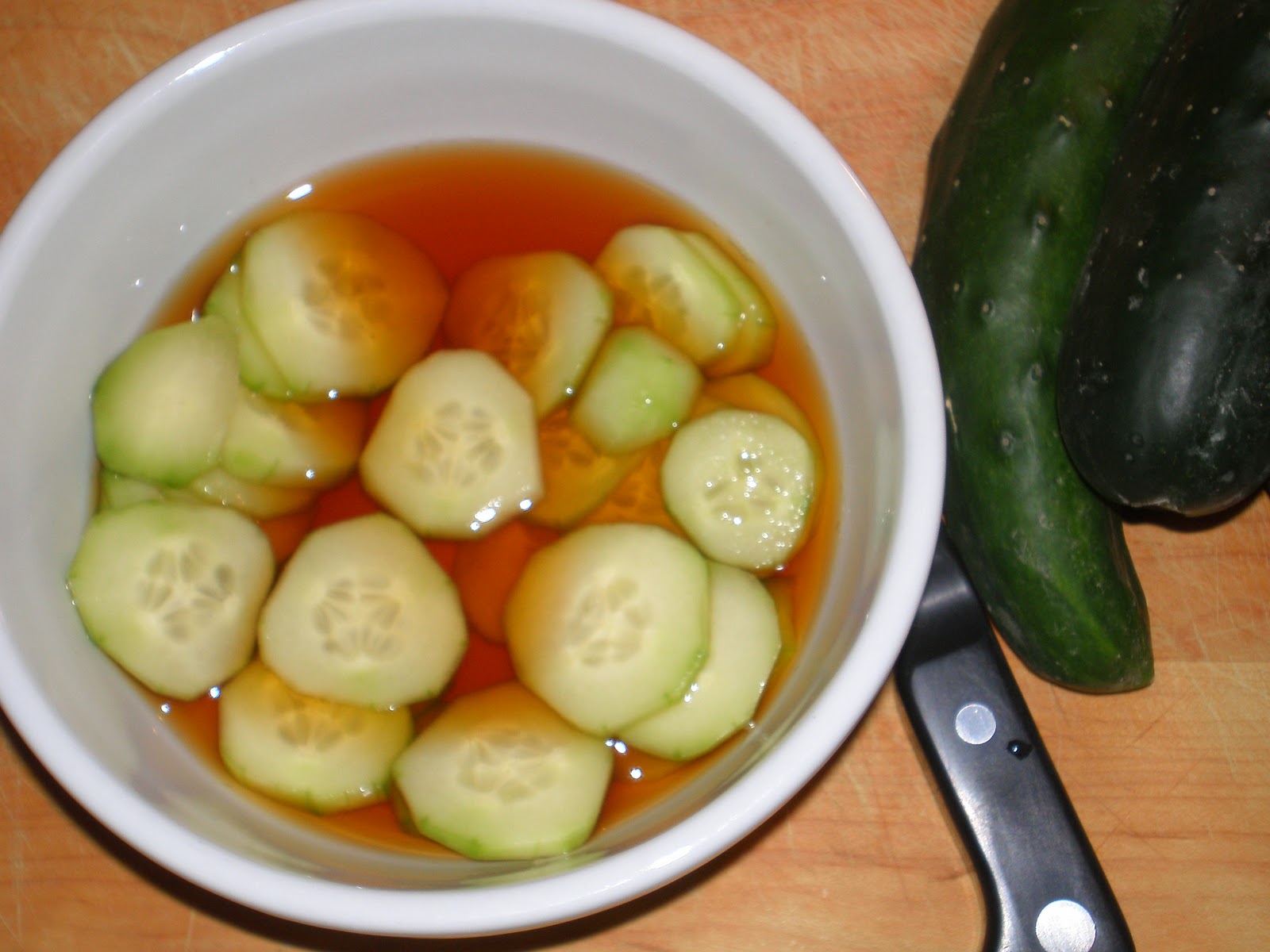
Now back to my cucumber. At the family meals, usually midday on Sundays, when seven or eight of us all sat down together my great-grandmother quite often put a bowl of sliced cucumbers soaking in vinegar on the table. It always seemed to be there. We all helped ourselves. I guess it might be considered a side dish, or a condiment. What they were to me were little bites of garden freshness. Cucumbers picked that morning, sliced and put into a bowl with vinegar and salt. Simplicity at its best. A sort of faux-pickle: crunchy, greenly bitter, mouth puckering and refreshing. I loved them. And as simple as it is, the dish is a standout in my childhood food memories. I think in part because the simpleness of the dish is evocative of who my great-grandmother was; hardworking, self-sufficient and uncomplicated.

This past weekend Robert and I went to see the new farmers' market at the Americana -- a popular, outdoor shopping mall in Glendale, California. I'd heard they were starting a farmers' market but I was also in no rush to go to one in a shopping mall. It turned out to be quite delightful. It's called Gigi's Farmers Market, happens every Saturday, and is easily on par with other local farmers' markets. As we wandered through my cucumber radar was up. As we rounded a corner to the next produce stall, I saw them sitting there in a small stack. The right size, the right green, with cucumber acne. I picked one up, it smelled like a cucumber. It felt like a cucumber. It looked like I'd found my cucumber. I asked the growers where they were from: Oxnard -- about fifty-nine miles away. Organic? Yes. Waxed? No. I bought six.


When I got home I made my great-grandmother's faux pickles and Robert and I ate them with our lunch. As I peeled and cut into the first one that cucumber smell rose up to meet my nose, and memories of our long ago family meals came rushing back to me.

Herewith...

Gramma Ora's Faux Pickles

Serves 4-6

Ingredients

  • 4 medium sized cucumbers, garden fresh or organic farmers market
  • Apple cider vinegar, enough to cover the cucumbers
  • 1 tsp. salt, ground sea salt if possible
Peel the cucumbers and slice into 1/4 inch rounds. Place in a serving bowl, just cover with vinegar, add salt. Salt may be adjusted depending on personal preference. If possible allow to sit at room temperature for a 1/2 hour before serving.

My Status: International Food Blogger Conference: I leave for Seattle on Thursday, May 14 and return home on Monday, May 18. The conference is Friday, May 15 - Sunday, May 17.

Robert and I leave for Paris, the Languedoc, Barcelona and Madrid on Sunday, May 24, returning home on Saturday, June 6.

Upcoming Posts: The Wedge Salad: a recipe, the origins of the salad and of Iceberg lettuce. France and Spain: if all goes well technologically, and time allows, I'll be posting blogs from Europe.

Bookmark and Share

Monday, May 11, 2009

The Local Report - Say Cheese

1.7 miles, about 5 minutes, from my home in Atwater Village.

Some may think it odd but I like eating out alone. I enjoy sitting and observing: the activity in the restaurant, the staff, other diners. There's something to the anonymous feeling of being alone in public. I especially like to dine by myself when I'm visiting other cities alone. It's a way to really get a feel for a place. Maybe it's not having the distraction of someone else to interact with. You can sit and observe, watch and listen, take it all in. And I do, and have. I have eaten alone in Paris, Milan, Rome, Hong Kong, New York,and San Francisco among other cities.

Local, Solo Dining

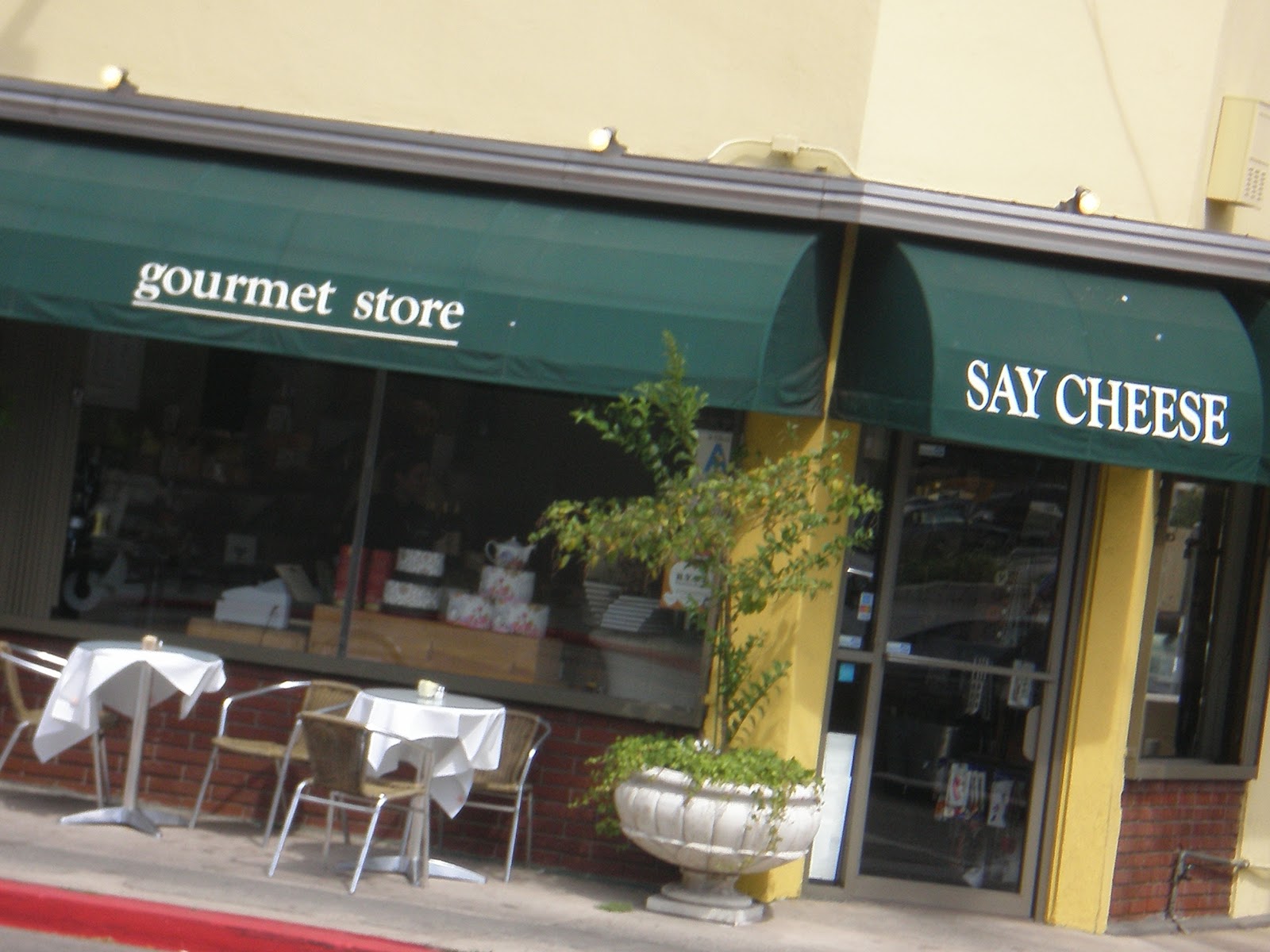
One of my favorite local places to dine solo is the little cafe in Say Cheese -- a combo cheese shop and cafe in the Silver Lake neighborhood of Los Angeles. I moved to Silver Lake from West Hollywood in 1998 and noticed Say Cheese when I first went to shop at Trader Joe's which is right next door. I have been going to Say Cheese for lunch ever since. I probably go in twice a month; the regular waitstaff know me. They automatically bring me an iced tea. The funny thing is that after all these years I still don't know any of their names. And I actually like that distance. Of all the years I've been eating there, I think I've been in twice with someone else. The place has its regulars who I see whenever I go. I don't know anything about them either other than what I observe; one woman, also a solo diner, who always reads a book while she eats.

Sandwiches, Salads and Cheese

What I like about Say Cheese is the attention to detail in all they do. The food is fresh and well-prepared. They serve lunch and weekend brunch only. The menu is primarily salads and sandwiches. Lately I have been getting the Hyperion Submarine -- a sandwich with 'artisan salami, fresh mozzarella, roasted red peppers, shaved red onion, tomato and mesclun with balsamic oil on baguette.' All their sandwiches come with a side of greens with a good house vinaigrette. Other sandwiches I like are the California Melt, an 'oven toasted sandwich' of 'oven roasted turkey, jack cheese, shaved red onion, mustard and aoili on rosemary bread', and the Ham I Am: 'European ham, smoked cheddar, shaved red onion and mesclun with raspberry spread on country wheat.'

The shop is split into two sections; the cafe on one side and the cheese counter on the other. I knew when I first went in, having been a cheese monger myself, that the place was in good hands. The stellar selection of cheeses, not too many to manage, the way they were displayed and how the staff handled and spoke about them won me over. I stopped in a few days ago after eating lunch and they had some wonderful little crottins - small, aged disks of goat cheese sprinkled with ash. Little rounds of perfection. They also offer other gourmet items; owner, Glenn Harrell, has a good palette and great taste, and only sells items of top quality whether it's cheese, coffee, chocolate, or olive oil. Say Cheese also offers catering.

I tend to go to Say Cheese for their sandwiches more so than to buy cheese, however I have purchased cheese their many times. I am going to wait to write about cheese, and local cheese shops for a later blog post. I do, however, have a recommendation for anyone wanting to learn more about cheese: pick up a copy of Steve Jenkins' book, 'Cheese Primer' -- all you'll want, and need, to know about fromage!

www.saycheeselosangeles.com

Say Cheese
2800 Hyperion Blvd.
Los Angeles, CA 90027
323-665-0545 (phone)
323-665-6465 (fax)

Recommended Reading: 'Cheese Primer' by Steven Jenkins

My Status: International Food Blogger Conference
: I leave for Seattle on Thursday, May 14 and return home on Monday, May 18. The conference is Friday, May 15 - Sunday, May 17.

Upcoming Posts: The Wedge Salad: a recipe, the origins of the salad and of Iceberg lettuce. Cucumbers: their season, history and a recipe for my great-grandmother's faux pickles.
Bookmark and Share

Wednesday, May 6, 2009

California


California is like food. Food for the soul. It gets under your skin like an ex-lover that never quite goes away. At least it has for me. Over the weekend I was trying to figure out what to write next. I haven't had time to research a couple of stories I'd like to write so I needed an alternative. On Sunday I drove from Los Angeles to the Central Coast to see my mother. She lives in Halcyon, a small town adjacent to Arroyo Grande. On the drive up it came to me. California. My state. The state where I was born, and grew up.

Paradise

There's a stretch of Highway 101 just north of Santa Barbara that gets me every time. It's an unpopulated area that starts at Goleta and runs north to the Gaviota Pass. It's just incredibly beautiful. It is 'California' to me. On one side of the highway, down sheer cliffs, the Pacific Ocean crashes onto near-deserted beaches. On the other side the Santa Ynez Mountain range rises up. The distance from mountains to ocean is short. There are fields with oak and eucalyptus trees connecting the mountains to the ocean. Depending on the time of day and year, the colors of the fields, the mountains, the sky and the ocean are stunning.

Origins

California is deep in my blood. I have tried living elsewhere. I have lived in New York City numerous times, and absolutely loved it. The most amazing city in the world. I have lived in France and loved it too. I have been back often. I've spent extended periods in Italy and South America. But I always miss California. I always return to it. It is my home. I'm a fifth generation Californian on my mother's side. My mother now lives where both sides of her family settled in the Santa Maria area of the Central Coast. I grew up in San Luis Obispo, north of Santa Maria. My maternal great-grandparents lived in Orcutt, a small town fifteen minutes south of Santa Maria. When I was a child I spent a lot time at Grampa Rollie and Gramma Ora's house. They were simple people who lived off their little plot of land. Most all of the vegetables and some of the fruit we ate came from their garden. My other maternal great-grandparents, the Balls, whom I never knew, lived in Santa Maria. My father was a Dust Bowl Okie. In 1940 his mother, dirt poor and left alone with five children in Oklahoma City, chased after my grandfather who had taken off to California with another woman. My grandmother, my father and his siblings eventually settled in San Francisco -- the city in which I was later born.

Food

Food enters our family history often. There's the story of my father, his four siblings and my grandmother crossing the California border and arriving in Southern California where they all picked oranges in the abundant citrus groves because they had no money for food. They cobbled enough money together to make their way to San Francisco where my grandfather was holed up with his new girlfriend. My mother also talks of trips to Los Angeles as a child in the 30s and 40s when L.A. was one big citrus grove; orange and lemon trees as far as the eye could see. Sadly, not the case anymore. I would have liked to have seen that L.A. One of my favorite stories my mother tells is about the trips she took with Gramma and Grampa Ball north on the 101 from Santa Maria to visit friends and relatives. Gramma Ball, quite the good cook, always packed a picnic of fried chicken and they would stop along the highway and eat lunch under an oak tree. It was always and only fried chicken never anything else. Back in those days and up to the 60s and 70s the family would stop along whatever stretch of road they were traveling to pick up produce that had fallen off the many trucks transporting fruits and vegetables. I remember doing this often as a child while driving through the Salinas Valley. Grabbing fallen celery, lettuce broccoli, and cabbage off the side of the road; it fed us for a week. When my mother was a child she went clamming with Grampa Rollie and Gramma Ora at Pismo Beach. They took clamming forks and old paint cans. Digging down an inch up came clam after clam. Sadly, clamming days at Pismo are over; it is all clammed out.

Photo: My mother, Dawn Goodman,
at Point Sal in the 1930s.


Place

Because my mother is an inveterate explorer we took a lot of road trips when I was a child. I am lucky to have seen almost every corner of this amazing state. Now, when I travel the same roads three generations of my family have traveled I feel a part of the place like I don't anywhere else. It's part of my being; the fabric of what makes me. My mother knows the oak tree along the 101 near Paso Robles where she and Grampa and Gramma Ball stopped to eat their fried chicken picnic those many years ago. I know driving up and down the coast to visit my mother that generations of my family have traveled the same roads, or earlier versions, and it fills me with a sense of pride and belonging to place. My family is California. The story of California is the story of my family. It is without any doubt under my skin; in my blood.

I don't mean to be completely myopic here. I know that other people from other states and parts of the country feel the same way about their own little slice of where they were born and grew up, where their family hails from. They have their own pride of place. As well they should. But for me it's all about California.

California -- a definition: The name 'California' is most commonly believed to have derived from a storied paradise peopled by black Amazons and ruled by Queen Calafia. The kingdom of Queen Califia or Calafia, according to Spanish adventure writer, Garci Rodriguez de Montalvo, was said to be a remote land inhabited by griffins and other strange beasts and rich in gold. He wrote, "Know ye that at the right hand of the Indies there is an island named California, very close to that part of the terrestrial Paradise, which was inhabited by black women, without a single man among them, and that they lived in the manner of Amazons. They were robust of body, with strong and passionate hearts and great virtues. The island itself is one of the wildest in the world on account of the bold and craggy rocks. Their weapons were all made of gold. The island everywhere abounds with gold and precious stones, and upon it no other metal was found." From -- Wikipedia

Top Photo: Ora and Rolla Goodman, my great-grandparents, barbecuing at a local park.

Upcoming Posts: The Wedge Salad: a recipe, the origins of the salad and of Iceberg lettuce. Cucumbers: their season, history and a recipe for my great-grandmother's faux pickles.

Bookmark and Share

Wednesday, April 29, 2009

Honey

An homage.

If I could be a beekeeper I would be. I love bees, always have. Not sure why exactly. I’ve been stung numerous times. I’m not afraid. I have two books on beekeeping, ‘The Shamanic Way of the Bee’ by Simon Buxton and “Beekeeping – A Practical Guide’ by Richard E. Bonney. One day I hSCAN0043ope to have a few hives of my own.

I also like what bees produce: Honey. My love affair with honey dates back to my childhood. My great-grandparents lived on a 17-acre parcel of land in Arroyo Grande, California that everyone called ‘The Ranch.’ Grampa Rollie raised sheep, chickens and Angus beef; they grew vegetables and had a few fruit trees; and Gramma Ora had a beautiful flower garden. They lived quite comfortably off this piece of land. The next door neighbors, the Van den Meters, had beehives and sold honey to my great-grandparents.

Traditions with Honey

Somewhere along the line, when I was probably four or five years old, a tradition began with my great-grandfather, myself and my younger sister, Traci. Traci and I would sit at the kitchen table with Grampa Rollie. He’d have a stack of toast on a plate, butter, and a jar of the neighbor’SCAN0003s amazing clover honey. He’d break off a piece of toast, put a dab of butter on it, spoon on some honey, then pop it into one of our mouths. Then he’d do it all over again for the other mouth. Back and forth, one in my mouth, one in my sister’s, until all the toast was gone. It was as if we were his baby birds and he was feeding us. Each visit required this ‘feeding’, and he always obliged. It’s a memory that I cherish to this day. I also remember the flavor of that clover honey. Fresh, unadulterated, like the clover fields the bees collected pollen in.

Mexican Honey

A year ago almost to the day, Robert and I were on a 10-day tour of the Yucatán Peninsula. While in Mérida we stopped in to see my friend, Chef Jeremiah Tower, who now makes Mérida his home base. One afternoon he took Robert and me to the local public market as he wanted us to try the Yucatán delicacy cochinita pibil – citrus marinated pork slow-roasted in banana leaves. The market was a wonder to behold. An assault of smells, sounds, and colors. Every type of food item from the area available. After a tour of the market, Jeremiah led us to a small stand that specializes in cochinta – his favorite purveyor of the pork dish. He ordered us a round of tacos and we sat at a little ceramic table in the middle of the market to eat. By the time we left I had eaten three cochinita tacos – each one topped with a sprinkling of crunchy chicharrón, or pork rind. They were amazing. He was right. I’ve had cochinta before but this was a notch above.

The reason I tell this story is that as we left the market Jeremiah stopped at another vendor, grabbed a plastic bottle of honey and told me I had to try it. So I did. I bought the bottle, a small plastic water bottle repurposed as a container for the amber honey. I managed to get it home to Los Angeles without getting caught at customs and have been eating it for the last year. And now, sadly, it’s gone. By the time we finished it off, it was all sugary and crystallized but still edible. And it was wonderful.

The flavor and color of honey is affected by the flowers that the bees collect pollen from. I was used to the more common clover and orange blossom honeys that are available in California. The kind I grew up eating at my great-grandfather’s knee. The Yucatán honey was a different experience completely; amber in color with a nice herbal bite to it. It’s flavor was sharper, more complex than what I was used to but I learned to love it. And I am very sad it is gone. A return trip to the Yucatán may be in the offing.

Local Honey

So to replace the Yucatán honey Robert and I went to the Atwater Village Farmers Market a couple weekends ago, and I bought some new honey from Aunt Willie at her litHoney 004tle stand. I opted for avocado this time to see what that tasted like and it’s delicious. The flavor is less sweet with molasses and butterscotch overtones. It’s a nice replacement to my plastic-water-bottle-Mexican-honey.

Aunt Willie has beehives where she collects her honey around the Los Angeles region: in La Habra, Fallbrook, Moorpark and San Bernardino. All roughly within 1o0 miles of Los Angeles. She explained to Robert and me that the bees, the farmers and she have a symbiotic relationship. They need her bees to pollinate their crops, and she needs their land to house her hives. Without bees to pollinate crops we wouldn’t have produce. They are a necessary component of our food cycle. Aunt Willie told us that bees via pollination can double a farmers yield. Even backyard beehives, like the ones I may eventually get if Robert will allow it, contribute to the food cycle.

French Honey

One final note: another honey that I learned to love, and have already blogged about, was the miel de sapin that I ate when I lived in France. The pollen is collected from the pine trees in the Vosges Mountains of Alsace – it has a distinctive, sharp, and piney taste to it.

I love bees, and I love honey.

Bookmark and Share

Friday, April 24, 2009

The Local Report - Canelé

3-26-09 002

.7 miles, about 3 minutes, from my home in Atwater Village.

A canalé is a specialty of the Bordeaux region of France. A small pastry with a soft custard center and a dark caramelized crust. They are eaten for breakfast, as a snack, and for dessert. Canalé is also a favorite neighborhood restaurant. Just a few walkable blocks from home. Robert and I were there on a recent Friday night. We have often wondered how the recession is affecting restaurants. It didn’t seem to be having much of an affect on Canalé this particular night. The restaurant was full and people were still waiting for tables when we left around 9:15 or so.

It’s great to see this place doing so well. The food has been called French-California-Mediterranean. And it is, but some of the menu items are classic French. Those are the ones I like the most. Like the bouef Bourguignon with buttered noodles I had on my first visit, and the pissaladiere with herb salad. They also have sides like pommes Anna, a very old-fashioned potato dish of layered potatoes and butter; starters like leeks vinaigrette, and brandade, a salt cod dish originating in the Languedoc and Provence regions of France. On our most recent visit we both had the bistro steak with sauce bordelaise, pommes Anna, and creamed spinach. Prepared perfectly. We were quite content at the end of the meal. They also offer a starter of Spanish ham, an Italian pasta dish in honor of the restaurant that was in the space for many years: Osteria Nonni, and a simple roast chicken. All less than classic French but equally good. Both the chef-owner, Corina Weibel, and general manager-owner, Jane Choi, come from other celebrated American restaurants: Campanile, and Lucques for Corina, and Pastis and Balthazar in New York for Jane.

The place has the feel of a Parisian bistro. Once inside it’s easy to pretend you are at a back250px-Caneles_stemilion street bistro in Paris. One Parisians living in the outer arrondissements might go to. The kitchen is open and practically in the narrow dining room which is part of the fun. There are a few seats at a counter looking into the kitchen, and a communal table in the front window. The staff is welcoming, attentive and congenial. We were seated near the front door so we watched as people arrived. It was obvious that a lot of the clientele comes from the neighborhood, and that many are regulars. The hostess knew a lot of the people coming through the door. That is what, after several visits now, I like most about the place. It’s unstuffy neighborhood vibe. It’s honest cooking. It’s not fancy nor does it need to be. And to top the meal off they offer you a warm canalé as you are going out the door.

http://www.canele-la.com/
  • Canelé
  • 3291 Glendale Blvd.
  • Los Angeles, CA 90039
  • 323-666-7133
Bookmark and Share

Wednesday, April 22, 2009

A Menu for Earth Day

Earth Day is today, Wednesday, April 22, 2009. In celebration of the day Martine Marcus and Judy Mancini of Burden Free Foods created a special menu using ingredients that come from within 100 miles of their home-base, Morristown, New Jersey.

Earth Day Menu

  • Local, Organic Squash & Apple Potage
  • New Jersey Free-Range, Organic Chicken Soup with Local Potato Dumplings
  • Local Herbed Polenta Toast with Sautéed Pennsylvania Mushrooms and New Jersey Aged Gouda Cheese
  • Salad of Local Greens Drizzled with Local Honey Vinaigrette
  • Apple, Blueberry, Maple Compote Over Local Cornmeal Pound Cake

These dishes are available today and tomorrow at Drip Coffee, 5 Hilltop Rd., Mendham, New Jersey, 973-543-3747. For those of you who don’t live in the Mendham area see the recipe below for Herbed Polenta Toast.

Local Livingshot5mush

‘Living Life Locally’ is a motto that more and more of us seem to be embracing. Since I decided to start this blog I have noticed an explosion of activity having to do with local, sustainable, organic living. There seems to be a real movement afoot. It’s not only due to the current economic malaise; it’s also about our changing climate, and our diminishing natural resources. The numbers of individuals, groups, farmers, foodies, restaurateurs, bloggers, writers and entrepreneurs embracing the local life are increasing daily. It’s our version of the 60s ideal of ‘living off the land.’

Earth Day

Earth Day actually dates back to April 22, 1969 – the date of the first Earth Day celebration. It was inspired by Wisconsin Senator Gaylord Nelson who announced that in the spring of 1970 there would be a nationwide grassroots demonstration on the environment. April 22, 1970 marked the beginning of the modern environmental movement with the goal of a healthy, sustainable environment. Thirty-nine years later the movement is still going strong, and is needed now more than ever.

100-Mile Radius

As mentioned in a previous post, the idea for 100 Miles came about because of my friend, Martine Marcus. To the very best of her ability she lives her life locally only buying food produced within a 100-mile radius of her Morristown, shot3 mushNew Jersey home. Her company, Burden Free Foods, cooks with organic ingredients and specializes in food that is locally sourced. They also have a dedicated gluten-free kitchen and make many gluten-free items. Martine and her business partner, Judy Mancini, create weekly menus for local residents too busy to cook. Their dishes are available at a small, local chain of coffee houses, Drip Coffee. They supply two of the chain’s stores with sandwiches, soups, salads, meals-to-go and baked goods. They also serve their community from early summer to late fall at the Morristown Farmer’s Market by creating original dishes using the market’s bounty. Dishes that can be taken home to eat later, or eaten on the spot. They also conduct on-site cooking demos using market ingredients.

Recipe - Herbed Polenta Toast with Sautéed Mushrooms

By Martine Marcus

In keeping with the living locally credo, try to source the below ingredients to within 1oo miles of your home base. It will be an educational and fun experiment.

Serves 4 to 6

Preheat oven to 350 degrees

Polenta

  • ½ cup coarse ground polenta
  • 2 cups water
  • 1 teaspoon salt
  • Pinch of black pepper
  • 1 bay leaf
  • 1 Tablespoon olive oil
  • 3 oz. grated hard cheese (aged gouda, Reggiano, etc.)
  • ¼ cup chopped fresh herbs (parsley, chives, etc.)

Boil water with bay leaf, salt, pepper and olive oil. Gently stir in cornmeal, reduce to simmer. Cook 15 minutes stirring occasionally. Stir in cheese and herbs. Pour into a small, oiled loaf pan. Pack tightly. Chill for a minimum of one hour (overnight is ok!) Turn out of pan, slice polenta into ½ inch thick slices. Toast slices in oven for 7 minutes on each side.

Mushroom Mélange

  • 4 cups assorted rough chopped mushrooms – we use oyster, white and Portobellos. If they need to be cleaned, just use a dry towel and lightly brush them
  • 2 Tablespoons olive oil
  • 1 clove garlic, chopped
  • ½ cup shredded hard cheese (aged gouda, Reggiano, etc.)
  • 1/8 cup lemon juice
  • Salt and pepper to taste
  • Chives, finely chopped

Put olive oil in hot heavy pan (I swear by my ‘Lodge’ cast iron skillet). Add garlic and chopped dry mushrooms. Add salt and pepper, shake pan while lightly browning mushrooms, cook until medium soft. Spoon mushrooms onto toasted polenta. Sprinkle with lemon juice. Spread a small handful of cheese over the mushrooms and sprinkle lightly with chives.

Bon appétit!

Bookmark and Share

Monday, April 20, 2009

The Local Report – Sweets for the Soul

0.8 miles, about 3 minutes, from my home in Atwater Village.

I have been wanting to give a shout out to Sweets for the Soul for sometime now. Primarily because it’s one of those small, local businesses that you want to see succeed. And also because they sell brownies! Yummy, rich, gooey, chocolate brownies. By using Valrhona chocolate exclusively they up the delicious factor Local 020 by 10.

The small company with an even smaller storefront on Glendale Blvd. in Los Angeles’ Atwater Village was started by Lilly LaBonge who gave up a demanding career in TV commercials and music videos to make brownies full-time. On offer are such items as Brownie Points, unctuous bite-sized rounds made with Valrhona cocoa and chocolate chips, Brownie Bliss, squares of chewy chocolate brownies made with unsweetened Valrhona chocolate and toasted pecans, Cocoa Bliss, heart-shaped brownies made with Valrhona cocoa and Valrhona chocolate, and last but not least, the Obama Brownie, made with Valrhona dark and white chocolate.

I have tried them all and they are all delicious. I like an intense chocolate flavor so my favorite is the Cocoa Bliss – double chocolate. For those readers who don’t live locally, Sweets for the Soul will send orders via Federal Express.

Purposely keeping the selection small while they start out, they will be adding new products over time. One of the upcoming items is Brownie Shards, the bits leftover in the pan after baking Brownie Points, to sprinkle on ice cream, freeze, or eat as sweet snack.

www.sweetsforthesoul.com

  • Sweets for the Soul
  • 3169 Glendale Blvd.
  • Los Angeles, CA 90039
  • 323-668-9338
Bookmark and Share

Friday, April 17, 2009

A Recipe for Quiche Lorraine

When I first returned from France in 1978 I was 18 years old and cooking up a storm for friends and family. Intricate five and six couNew Years 2008 015rse French meals. Amuse-bouches, appetizers, main course, salad course, cheese course, and dessert course. One of my favorite things to make was a dish I discovered while living in Alsace – la tarte a l’oignon, or onion tart. It was simple, delicious and very satisfying.

The recipe in French that I used to make the dish listed pâte brisée for the crust. A pâte brisée is translated as ‘short paste,’ ‘pastry dough, or ‘pie crust’ in ‘Mastering The Art of French Cooking.’ All good except for some unknown reason I found a whole wheat pie crust in the vegetarian cookbook ‘Laurel’s Kitchen’ that I started using. It’s not because I am vegetarian. My reasons for this decision are now lost to time. It is simply an amazing piecrust. One I have made often.

When Robert and I decided to stay in this past New Year’s Eve and make a quiche I knew I’d be making that whole wheat piecrust. It had been a long time since I’d made a quiche, or even an onion tart, and I was excited to do so. We had even purchased a beNew Years 2008 018autiful ceramic quiche pan from Sur La Table just for the occasion. I hauled ‘Mastering The Art’ out so Julia could give me guidance, and in reading the recipe I was reminded of what a quiche really is.

Her translation of quiche is ‘open-faced tart.’ Her translation of quiche Lorraine is ‘Cream and Bacon Quiche’. Heavy cream, eggs and bacon. That simple. A lot of French cooking is fairly uncomplicated with a minimum of ingredients and for good reason. By keeping the ingredient list to the few the flavors of those included stand out. I think we tend to want to add a lot of ingredients to a dish like quiche and that often takes away from the simplicity of flavors that could be there. Julia does go on to allow for other types of quiches in the book; cheese, Roquefort, tomato, and so on. The only alteration to her recipe we made was to add a little gruyere cheese.

Final note (before recipes): a friend recently pointed out that The B-52’s recorded a song called ‘Quiche Lorraine.’ If you are so inclined to play it while cooking, please feel free. Forthwith my version of Quiche Lorraine. Add a green salad and you have a meal.

Quiche Lorraine

Adapted from ‘Mastering The Art of French Cooking’ by Julia Child, Louisette Bertholle, Simone Beck

Serves 4 to 6

Preheat oven to 375 degrees

3-4 ounces lean bacon (6-8 slices, medium thickness)

1 quart water

An 8-inch partially cooked pastry shell placed on a baking sheet; see below for a whole wheat piecrust recipe

3 eggs

1 ½ - 2 cups whipping cream, or half and half

½ cup grated gruyere cheese

½ tsp salt

Pinch of pepper

Pinch of nutmeg

1-2 Tb butter cut into pea-sized dots

Cut bacon into pieces about an inch long and ¼ inch wide. Simmer for 5 minutes in the water. Rinse in cold water. Dry on paper towels. Brown lightly in a skillet. Press bacon pieces into bottom of unbaked pastry shell.

Beat the eggs, cream or half and half, and seasonings in a mixing bowl until blended. Stir in cheese. Pour into pastry shell and distribute the butter pieces on top.

Set in upper third of preheated oven and bake for 25-30 minutes or until quiche has puffed and browned. Slide quiche onto a hot platter and serve.

Piecrust

Adapted from ‘Laurel’s Kitchen’ by Laurel Robertson, Carol Flinders, and Bronwen Godfrey

My one change to this recipe is to replace margarine with butter. And I always opt for the combination of whole wheat flour and whole wheat pastry flour. I have included the recipe pretty much as the book lays it out so it can be used for other purposes. For the above quiche recipe do not make a lattice.

New Years 2008 005

1 1/2 cups whole wheat flour, or combination of whole wheat and whole wheat pastry flour

1/2 cup wheat germ

10 tablespoons of butter

1 tsp salt

4-6 tablespoons cold water

Stir together the flour, wheat germ, and salt. Cut the butter into the dry ingredients with two knives or a pastry cutter. When dough is the consistency of rolled oats, sprinkle with the water, using just enough to hold the dough together. Using cupped fingers, work the dough together quickly and gently. As soon as it will hold together, form into a ball. For best results, refrigerate for at least a half-hour, or even overnight, but be sure to remove from the refrigerator and hour before rolling it out.

Preheat oven to 400 degrees.

Press the dough out into a thick disc. Roll to size on a lightly floured surface, or between sheets of waxed paper, or on a pastry cloth. Gently roll the dough over the rolling pin and onto a pie plate, easing it loosely into the plate. If it should stick to the table, slide a long sharp knife underneath, and if it should tear, patch with extra dough once it is in place. Gently press the dough into the plate so there are no air pockets. Cut off the excess with a sharp knife, but be sure to make the rim extra thick so it won’t burn. If you are going to fill the pie before baking, you may use the extra dough for lattice.

Form a rim, and prick pie shell all over with a fork.

Bake for 10-12 minutes, cool, and fill. Bake for just 7 minutes if your recipe calls for a partially baked crust.

Makes one 10-inch crust, or crust and lattice for one 8-inch pie.

Bookmark and Share